How I Built a Full-Stack Appointment System That Cut Booking Time by 40%
I built a full-stack appointment system with the MERN stack that cut booking time by 40%. This is a breakdown of every real decision that went into it — JWT auth with refresh tokens, MongoDB schema trade-offs, real-time slot updates with SSE, and the two things that broke the moment it hit production.
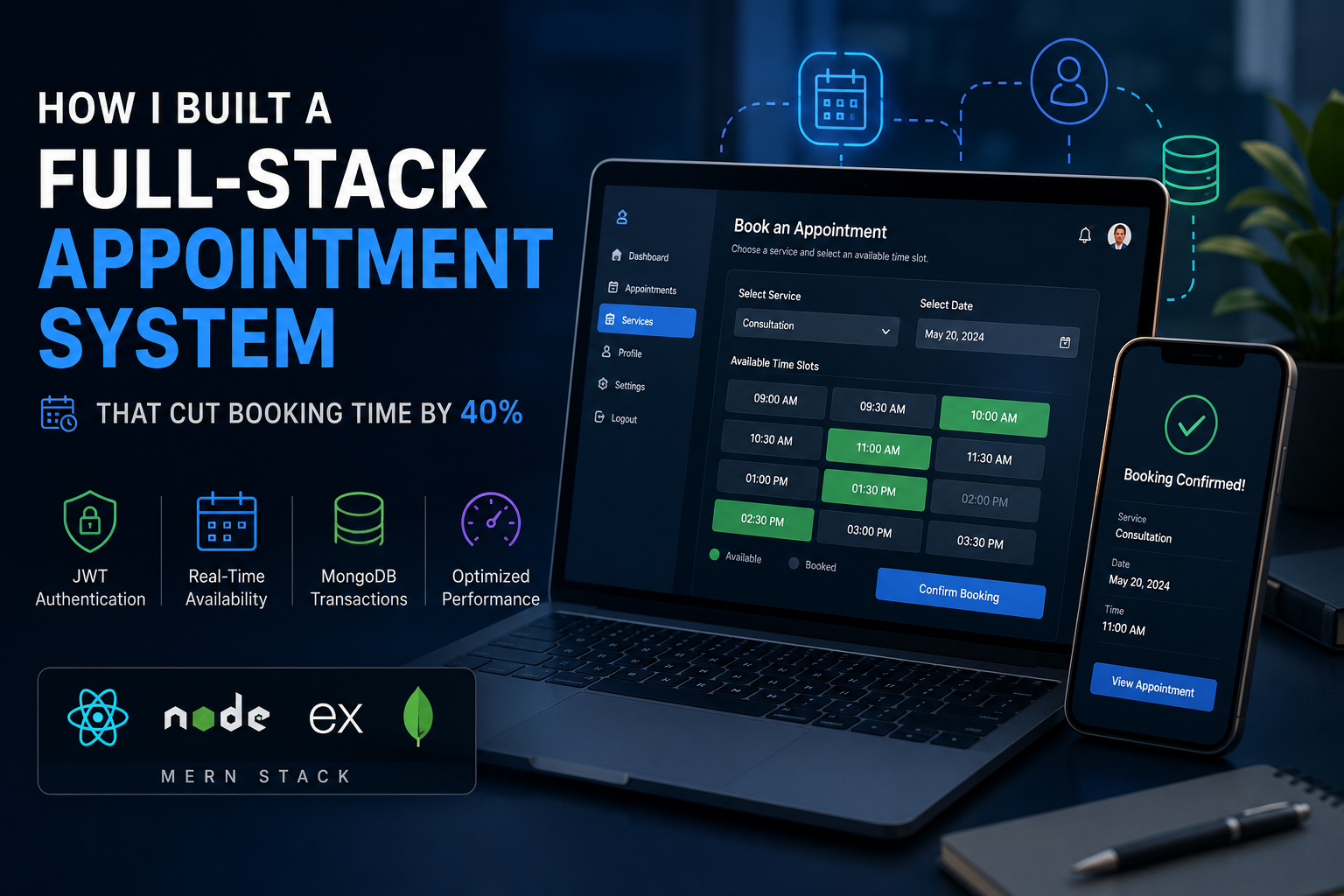
Most developers build a to-do app or a weather widget as their first “real” project. I wanted to build something that solves an actual workflow problem — the kind where the pain is visible, the stakes are real, and the edge cases hit you at 11 PM on a Tuesday. That’s exactly what I ran into while building an Online Appointment System from scratch using the MERN stack. This article breaks down the architecture decisions I made, the trade-offs I accepted, and the specific problems that pushed my understanding of full-stack development forward.
If you want to see the finished product in context, it lives alongside my other work on my portfolio projects page.
Why a Scheduling System Is Harder Than It Looks
The surface requirement sounds straightforward: let users book time slots. But the second you start thinking in terms of concurrent requests, time zones, session state, and slot collision, the complexity compounds fast.
The first architectural question I had to answer was where availability logic should live. I initially drafted it on the client side — React state tracking which slots were taken. That broke immediately in testing when two users opened the booking page simultaneously and both saw the same slot as available. Classic race condition.
The fix was to move all availability checks to the server, enforce atomic slot reservation in MongoDB using transactions, and treat the client as a dumb display layer for that particular interaction. The React UI sends an intent to book; the Node/Express API either confirms or rejects it after checking the database. No slot is ever “taken” until the server says so.
This sounds obvious in retrospect, but getting there meant unlearning the instinct to trust client-side state for anything that touches shared resources.
Schema Design: Getting MongoDB Right the First Time
One of the biggest decisions in a MERN project is how aggressively you embed versus reference documents in MongoDB. For this system I had three core collections: users, services, and appointments.
My first draft embedded everything. An appointment document had the full user object nested inside it, along with the full service object. Querying a single appointment was fast — one round trip. But updating a user’s email meant hunting through every appointment document and patching each one. That’s a data integrity nightmare at scale.
I switched to a reference-based model. Appointments store userId and serviceId as ObjectIds. Joins happen at the application layer using populate() in Mongoose. Yes, there are more database round trips. But the data stays consistent, and the trade-off is completely worth it for a write-heavy system like scheduling.
The key lesson: embedding makes reads fast and writes painful. Referencing makes writes clean and reads slightly more expensive. Know your read/write ratio before you commit to either.
JWT Authentication: What the Tutorials Don’t Tell You
Every beginner MERN tutorial shows you how to sign a JWT and attach it to an Authorization header. What they skip is what happens when that token expires while a user is mid-session, or what you do when a user changes their password and you need to invalidate all existing tokens.
For this project I implemented a dual-token strategy: a short-lived access token (15 minutes) and a longer-lived refresh token (7 days) stored in an httpOnly cookie. When the access token expires, the client silently hits a /auth/refresh endpoint. If the refresh token is still valid, the server issues a new access token. If not, the user gets redirected to login.
The httpOnly cookie detail matters a lot here. Storing the refresh token in localStorage exposes it to any JavaScript running on the page, which means any XSS vulnerability becomes a session hijacking vector. The cookie approach keeps it out of reach of client-side scripts entirely.
The trade-off is that this pattern adds complexity to both the server and the client. You need refresh logic in your API interceptor (I used Axios interceptors for this), error handling for concurrent requests that all fail simultaneously, and a token blacklist strategy for logout. I handled the blacklist by storing invalidated token JTIs in a Redis-adjacent MongoDB collection with a TTL index — simple, and it worked.
Real-Time Availability: Avoiding the Polling Trap
The initial version of the booking UI polled the server every 10 seconds to refresh available slots. It worked, but it was wasteful and the UX felt sluggish. If someone booked a slot, other users on the page wouldn’t see it disappear for up to 10 seconds.
I replaced polling with Server-Sent Events (SSE). When a booking is confirmed, the server pushes an update to all connected clients watching that service’s availability. The client updates its local state immediately.
I specifically chose SSE over WebSockets for this use case because the communication is one-directional — the server pushes updates, the client doesn’t need to push back. SSE is lighter, works over standard HTTP, and doesn’t require a separate library. WebSockets would have been over-engineered here. Knowing when NOT to use a technology is as important as knowing how to use it.
The performance difference was immediate. Page interactions felt snappy, and the slot collision problem essentially disappeared for concurrent users.
Express Middleware Architecture That Scaled Cleanly
By the time I had authentication, validation, error handling, and rate limiting all running, my route files were becoming unreadable. Everything was stacked inline. I spent a week refactoring the middleware layer and it’s one of the best decisions I made on the project.
The final structure separated concerns cleanly:
- Authentication middleware verifies the JWT and attaches req.user
- Role middleware checks whether req.user has the permission to hit a given route
- Validation middleware uses Joi schemas to sanitize and validate request bodies before they ever reach route handlers
- Error middleware sits at the bottom of the stack and catches anything thrown by async route handlers via a wrapper utility
The async wrapper was a small but meaningful quality-of-life addition. Instead of wrapping every route in a try/catch, I wrote a catchAsync higher-order function that wraps the handler and forwards any thrown error to next(). Every route handler stayed clean and readable; error handling was centralized.
This kind of middleware thinking — treating the request pipeline as a series of composable, single-responsibility functions — is something I carry into every Express project now.
What Broke in Production (And How I Fixed It)
The most instructive phase of any project is when it leaves your local machine. Two things broke almost immediately when I deployed to a live environment.
The first was CORS. My local setup had localhost:3000 and localhost:5000 on the same machine, so the browser never flagged cross-origin requests in development. In production, the frontend and backend were on different subdomains. I had to configure CORS properly in Express — specifying the exact allowed origins, allowed headers, and setting credentials: true to allow cookies to be sent cross-origin. Forgetting credentials: true in the CORS config broke the entire refresh token flow silently, which took a frustrating hour to trace.
The second was environment variables. I had been sloppy about .env management locally — some config values were hardcoded in comments, some were in the file, and some I’d just typed directly into the code “temporarily.” In production, none of the temporary ones existed. I rebuilt the config layer to load everything from process.env at startup and throw a clear error if any required variable was missing. Fail fast, fail loudly — much better than mysterious runtime failures.
Performance Considerations I’d Apply Differently Next Time
Looking back, there are a few optimizations I’d bake in earlier rather than retrofit.
MongoDB indexing was something I added too late. I was running queries on appointments filtered by userId, serviceId, and date without compound indexes on those fields. As the test dataset grew, query time climbed noticeably. Adding a compound index on { userId: 1, date: 1 } and { serviceId: 1, date: 1 } dropped query times significantly. Index design should happen alongside schema design, not after the fact.
On the React side, I had components re-rendering on every state update because I was storing too much in a single top-level context. Splitting the context into domain-specific slices — auth state separate from booking state separate from UI state — reduced unnecessary re-renders and made the component tree easier to reason about.
I also never implemented pagination on the admin panel’s appointment list. It worked fine with 50 records in testing, but it would fall apart with real data. That’s a known tech debt item, and naming it explicitly in the codebase is something I now do deliberately — a comment that says “this will break at scale, here’s why, here’s the fix” is more valuable than pretending the problem doesn’t exist.
What This Project Actually Taught Me
Building this system taught me that good software development is mostly about managing trade-offs rather than finding perfect solutions. Every architectural decision — embedding vs referencing, SSE vs WebSockets, JWT strategy — involved giving something up to get something else. The skill is knowing what you’re trading and why.
It also reinforced that the hardest bugs are the ones that don’t exist locally. Environment parity between development and production isn’t a nice-to-have; it’s a discipline. Docker would have helped here, and it’s something I’m incorporating into current projects.
The 40% efficiency improvement over manual booking workflows wasn’t a number I pulled from thin air — it came from timing actual booking flows against the baseline process. Measuring outcomes, not just shipping features, is what turns a project into a case study.
If you’re building something similar or want to talk through any of these decisions, my contact page is always open. I enjoy these conversations.